Select your language


The research question is the core of your academic work. It defines what you actually want to investigate, structures your argumentation, and determines which methods are appropriate. At the same time, it is closely linked to the so-called research gap: without a clear gap, your work can easily become “interchangeable” because it is not clear what contribution you are making to the existing literature. This text is about how to get from a broad topic to a viable research question—and how to justify it in the context of a research gap.
1. Topic, Research Problem, Research Question, Objective
Often, all you have at the beginning is a topic: “Digital platforms in public administration,” “Use of AI tools by students,” “Acceptance of self-service BI in companies.” However, a topic alone is not enough to plan a scientific paper. You need a clearly formulated research question, an outlined research problem, and a specific objective.
The research problem describes in a few sentences which content-related problem or open question interests you. It is more narrative and can be formulated in an application-oriented way: Where do you observe difficulties, inconsistencies, or open issues in practice and research?
The research question is the precise, empirically or conceptually answerable question that is at the heart of your work. It should be formulated in such a way that it can be meaningfully pursued within the available time, data, and methods. It is often helpful to formulate it as a W question (what, how, why).
The objective describes what your work should achieve – typically in terms of a contribution to literature and/or practice. It links the research problem, research gap, and research question and makes it clear why it is worth pursuing.
A simple example:
- Topic: “Self-service BI in medium-sized companies.”
- Research problem: Many companies invest in self-service BI solutions but do not achieve the desired usage in their departments.
- Research question: “How do organizational conditions influence the actual use of self-service BI tools in medium-sized companies?”
- Objective: The work should identify key influencing factors and thus highlight starting points for the successful introduction of self-service BI.
2. What is a research gap?
A research gap describes what has not been addressed or has been addressed insufficiently in the existing literature. It is important to note that a research gap is not a “blank slate,” but rather results from a systematic examination of existing work.
In practice, various types of gaps have become established:
- Context gap: A phenomenon has been studied primarily in certain contexts (e.g., large companies, certain countries), while other contexts are underrepresented.
- Methodological gap: There are many quantitative studies, but hardly any qualitative insights—or vice versa.
Conflicting findings: Studies come to different conclusions that have not yet been well explained. - Theoretical gap: Certain theories have not yet been systematically applied in a field.
- New phenomena: Practically relevant developments (e.g., new technologies) have not yet been extensively studied in the literature.
A well-formulated gap clarifies where previous work has failed or what it has omitted, without devaluing earlier research. The gap should reveal why it makes sense and is feasible to address your specific question.
3. How do you find a research gap?
The basis for a research gap is always a structured overview of the current state of research. A systematic approach will help you with this:
- Start with review articles
First, search for review articles or meta-analyses on your topic, for example in journals on business informatics or related disciplines. These typically discuss research desiderata and open questions. - Search specifically for current individual studies
Supplement reviews with more recent empirical work that specifically addresses your topic. Pay particular attention to the “Limitations” and “Future Research” sections, as authors often explicitly identify research gaps there. - Take notes on gaps
As you read, note which aspects are repeatedly described as “under-researched,” where results diverge, or which contexts have been left out so far. These notes will form the basis of your gap analysis later on. - Categorize the gap
Assign your observations to one or more gap types. This will allow you to clarify later whether you are addressing a new context, a new method, or a theoretical perspective, for example.
By documenting this process, you create a comprehensible basis for justifying your research question in the text.
4. From topic to research question
Many students start with a broad area of interest and wonder how to arrive at a specific research question. A simple approach consists of four steps:
- Narrow down the topic
Reduce your topic to a clearly defined area. Instead of “digitalization in healthcare,” try “use of patient portals in urban hospitals.” - Identify key concepts
Consider which core concepts play a role in your topic area (e.g., intended use, perceived usefulness, organizational support) and search specifically for literature on these topics. - Examine relationships between concepts
Ask yourself which connections have already been described in the literature and where there are still open questions. This is where the first idea for your research question emerges. - Formulate and refine your research question
Draft a first version of your question and check it against criteria such as clarity, feasibility, and connection to the literature. Often, several iterations are necessary until the question is truly tailored to your needs.
For example, the topic “Use of collaboration platforms in higher education” can be transformed through this process into a research question such as: “How do perceived autonomy support and social presence influence the continued use of collaboration platforms in master's programs in business informatics?”
5. Formulation aids for research gaps and research questions
When formulating research gaps and research questions, standardized sentence templates that you can adapt to your topic will help you.
Typical “gap” formulations in German:
- „Bisherige Studien konzentrieren sich vor allem auf …, während der Kontext … bislang kaum berücksichtigt wurde.“
- „Obwohl zahlreiche Arbeiten den Einfluss von … untersucht haben, ist bislang wenig darüber bekannt, wie …“
- „In der bestehenden Literatur finden sich unterschiedliche Ergebnisse zur Rolle von …, sodass offen bleibt, …“
Corresponding formulations in English:
- “While prior research has extensively examined X, little is known about Y in the context of Z.”
- “Existing studies report conflicting findings regarding ..., which raises the question of ...”
- “Although numerous studies have addressed ..., the role of ... remains underexplored.”
Clear questions are suitable for the research question itself:
- „Wie beeinflusst … die …?“
- „Welche Faktoren tragen dazu bei, dass …?“
- „Inwieweit unterscheidet sich … zwischen … und …?“
In English:
- “How does X influence Y in the context of Z?”
- “What factors contribute to ...?”
- “To what extent does ... differ across ...?”
It is important that the question fits your planned methodological approach not only linguistically, but also in terms of content.
6. Common Mistakes and a Brief Checklist
In practice, similar mistakes are repeatedly encountered in research questions and gaps:
- The question is too broad (“How does digitalization affect companies?”).
- The question is too vague (“What impact does technology have?”).
- The question does not fit the available method or database.
- The research gap is asserted rather than proven because the literature has not been systematically reviewed.
- No clear connection is made between the gap, the question, and the objective.
A short checklist can help you avoid these mistakes:
- Is the research gap visibly supported by literature in the text?
- Is the research question clear and expressed in a W-formulation?
- Can I provide a meaningful answer with my methods and resources?
- When reading, can third parties (supervisors, fellow students) recognize the specific contribution of the work?
- Are the problem, gap, question, and objective logically related to each other?
If you can answer most of these questions with “yes,” you are a big step closer to a viable research question.
7. Research Questions in Typical Methodological Settings in Information Systems
Certain methodological settings occur particularly frequently in Information Systems, such as surveys, qualitative case studies, experiments, and design-oriented research (design science). Each of these approaches suggests how a research question can be tailored. It is crucial that the question and method are compatible and that the research gap reveals why this particular setting was chosen.
7.1 Survey Studies
Survey studies are suitable when relationships between constructs are to be examined quantitatively or differences between groups are to be analyzed. The research question is then often focused on correlations (“How is X related to Y?”) or differences (“Do groups A and B differ with regard to X?”).
Examples:
- “How do perceived usefulness and subjective norms influence the intention to use self-service BI tools in medium-sized companies?”
- “To what extent do students from different disciplines differ in their willingness to use AI-based writing tools for academic work?”
In these examples, it is clear that variables can be quantified and statistically evaluated. The research question is formulated in such a way that a questionnaire with appropriate scales can be used to answer it.
7.2 Qualitative Case Studies
Qualitative case studies are suitable when processes, meanings, and contexts are the main focus, for example, when introducing new systems, designing transformation processes, or using innovative technologies in specific organizations. The research questions here are often descriptive or explanatory in nature, without testing fixed hypotheses in advance.
Examples:
- “How does the introduction of a central data analysis ecosystem in a public administration shape organizational routines and decision-making processes?”
- “How do employees in a hospital experience the introduction of a mobile documentation system in their everyday nursing work?”
The focus in each case is on the “how”: processes, perceptions, and interpretations are examined in the organizational context. The method (e.g., guided interviews, observations, document analysis) is suitable for providing detailed insights into these processes.
7.3 Experiments
Experiments are used when cause-and-effect relationships need to be tested under controlled conditions. In business informatics, for example, the focus is on how different design variants of user interfaces, dashboards, or recommendation systems influence user behavior.
Examples:
- “How does the presentation of data protection information (compact vs. detailed) affect the willingness to use a health app?”
- “What influence does the visualization of uncertainty in forecast dashboards have on the quality of decisions made by managers?”
The research questions are formulated in such a way that it is clear which independent and dependent variables are being considered and which behavior or assessment is to be measured. A research gap may arise here, for example, if certain forms of presentation or user groups have not yet been experimentally investigated.
7.4 Design Science Research
Design science research focuses on the development and evaluation of artifacts such as methods, models, prototypes, or decision support systems. The research questions often relate to which design principles contribute to solving a specific problem or how an artifact works in a given context.
Examples:
- “How can a decision support system be designed that helps project managers in public IT projects prioritize risks?”
- “Which design principles contribute to increasing the transparency of AI-supported recommendation systems for end users?”
Such questions make it clear that an artifact should be developed and evaluated in a suitable context. The research gap here often lies in the fact that existing approaches do not yet address certain requirements or are only described for other contexts.
7.5 Mixed-method Approaches
Mixed-method studies combine qualitative and quantitative approaches to examine a phenomenon from different perspectives. Research questions can, for example, be initially exploratory (qualitative) and then evaluative (quantitative).
Example:
- “How do employees describe the introduction of a new collaboration tool in everyday project work, and to what extent can the resulting influencing factors on usage intention be quantitatively confirmed?”
In such a setting, the research gap may lie in the fact that only qualitative case studies or only standardized surveys exist so far, but a combination of both perspectives is missing.
7.6 Compatibility of Research Question, Research Gap, and Method
Regardless of the chosen methodological setting, the research question, research gap, and approach should be compatible in terms of content. A question that focuses on differences between groups requires a data basis that allows for appropriate comparisons. A question that focuses on processes and interpretations can only be answered to a limited extent with a highly standardized survey. In business informatics, it therefore makes sense to consider which methodological setting is realistic and appropriate for answering the question when formulating the research question.
When the topic, gap, question, and method are coherently aligned, a clear line emerges: the literature reveals a gap, the gap leads to a precise question, and the question leads to an appropriate study design. This not only makes it easier to carry out the work, but also makes it easy for readers to follow.
Writing a student paper scientifically is not easy the first time. There is a lot of literature on the topic of scientific writing. In the end, it's all about the structure and evidence that leads to the gain in knowledge. At this point, not only a few useful tips and supporting literature references, but also the reference to a framework that allows the author a goal-oriented writing.
What Does Academic Writing Mean?
Academic writing refers to the systematic, comprehensible, and verifiable presentation of a research process. The focus is on clear argumentation, the reasoned use of existing literature, and a transparent description of the methods used. The aim is to present one's own contribution to the academic discussion in such a way that other researchers can understand, classify, and further develop it [1].
At the latest when writing the master's thesis, it is called independent editing. There is not always an identical procedure, and it differs in the disciplines. There are a few basic rules to follow.
Structure
The following structure is based on a typical empirical thesis and can be easily adapted depending on the project:
- State of the Art: Presentation of key terms, theories, and previous findings.
- Research Questions: Derivation of research questions from the literature (see also Research Question and Research Gap in Information Systems).
- Formulation of Hypotheses (if appropriate): Derivation of testable assumptions.
- Methodological Approach: Description of the method (e.g., survey, Case Study, Design Science) and data collection.
- Analysis: Preparation and evaluation of the data.
- Results: Structured presentation of the most important findings.
- Discussion of the Results: Classification in the state of research, critical reflection, and derivation of implications.
It is important that there is a common thread running through all chapters: From the problem definition to the theoretical embedding and method to the results and conclusion, the work consistently aims to answer the research question.
Language Style and Form
In addition to the structure of the content, language style is a key element of academic quality. The following applies to work in business informatics:
- Factual, precise language is preferable; long, convoluted sentences should be avoided.
- The terms used should be defined as consistently as possible and used uniformly throughout the text.
- Statements must be substantiated by sources; quotations and paraphrases must be correctly identified.
- The formatting (headings, tables, figures, lists) should follow the guidelines of the department and be consistent throughout the document.
Careful language and formal consistency improve readability and help to make the content more visible. [1]
Reflection and Orientation Framework
The questions linked on this page and the framework presented are intended to help you plan and review your work in a structured manner. You can use the list of questions, for example, to:
- systematically review an exposé,
- sharpen the common thread between research question, theory, and method,
- and specifically check before submission whether the core requirements for an academic paper have been met.
In-Depth Analysis: Research Question and Research Gap
Well-founded research questions and a clearly formulated research gap are central components of any scientific paper. While the structure of the paper provides a framework, the research question determines what is actually to be investigated—and the research gap determines why this investigation is worthwhile.
Many students start with a topic (“Digitalization in ...,” “Use of AI tools in studies”) and then realize that it is still unclear what specific question they are working on and how it relates to the existing state of research. This is exactly where a clear separation of topic, research problem, research question, objective, and research gap helps.
I have described this process in detail on a separate page Research Methods and linked it to typical methodological settings in business informatics (survey, Case Study, Experiment, Design Science, mixed methods). There you will find:
- a classification of topic, research problem, research question, and objective,
- an introduction to different types of research gaps,
- a possible approach “from topic to research question,”
- formulation aids for the research gap and research question (German/English),
- examples of research questions in typical methodological approaches in Information Systems.
You can find more detailed information here: Research Question and Research Gap in Information Systems.
Structure and Evidence
The paper has a clear thread with a stringent argumentation, which is supported by evidence.
Especially general statements should be used carefully because they have to be valid. Words like many, mostly, frequently, little, often should be avoided and should serve as a summary. Example: Instead of "many", "8 out of 10" is a statement with higher value and validity. After making this statement, "many" can be used again in a conclusion - if no other way is possible. However, please always use it with caution. But what is an optimal structure and how do you get the necessary clarity in the text to also publish successfully?
Optimal Structure and Clarity for Successful Publications
We know that contributions are often lost due to a lack of structure and clarity. Often there is a lack of time to set the right framework, to understand the community or economically the market or to know a feasible structure. In this context, my colleagues and I have written an article (Publish or Perish: A Scientific Blueprint for a Journal Article) as a framework recommendation for structuring scientific papers to provide them as authors a scientific blueprint for most submissions especially in the International Journal of Engineering Pedagogy (iJEP).
Our many years of expertise and experience in the field have enabled us to gain valuable insights into the preparation of papers. We highlight typical mistakes and present insights to avoid them. Furthermore, we take a look at the specific parts of an article to clarify the expectations of the editors. Additionally, we present a lightweight approach that authors can use to quickly dive into writing.
Our proposed framework helps them authors organize their thoughts, make the structure of the paper publishable, and reduce time to market. This proven blueprint can be used by them as authors to streamline their writing processes to make their contributions more successful. We are convinced that this approach will help you as authors to optimally prepare your contribution and pave the way to publication.
Literature References
I personally found two books very helpful:
- Esselborn-Krumbiegel, H. (2022): Richtig wissenschaftlich schreiben: Wissenschaftssprache in Regeln und Übungen, 7th ed., UTB GmbH, Paderborn
and
- Müller, E. (2013): Schreiben in Naturwissenschaften und Medizin, UTB GmbH, Paderborn.
Further books for scientific writing
Core Literature
- Gottlieb, M; Utesch, M (2022): Publish or Perish: A Scientific Blueprint for a Journal Article, International Journal of Engineering Pedagogy (iJEP), 12(3), pp. 171–177, doi: https://doi.org/10.3991/ijep.v12i3.28253.
Further Literature
- [1] Heenes, W., Elsner, I., Reuter A. (2010): Wissenschaftliches Schreiben in der Informatik, TU Darmstadt, https://www.owl.tu-darmstadt.de/media/owl/responsive_design/owl_anleitungen_pdf/0036_WissSchreiben_in_der_Informatik_2020-06.pdf, acessed at 03/02/2026
- Esselborn-Krumbiegel, H. (2022): Richtig wissenschaftlich schreiben: Wissenschaftssprache in Regeln und Übungen, 7th ed., UTB GmbH, Paderborn
- Müller, E. (2013): Schreiben in Naturwissenschaften und Medizin, UTB GmbH, Paderborn.

Introduction: The AIS Basket of Eight and its role in Information Systems
The so-called “AIS Basket of Eight” is a group of eight leading journals in the field of Information Systems compiled by the Association for Information Systems (AIS). These journals are considered particularly influential in the international scientific community, both in terms of the theoretical foundation and the methodological rigor of the published articles. For students and doctoral candidates, the basket offers a systematic introduction to the core literature in the field and also serves as a point of reference for assessing the reputation of specific publication venues.
The “Basket of Eight” was historically created against the backdrop of efforts to make research performance in the field of information systems more comparable internationally and to establish uniform quality standards for journals. The selection is intended to ensure that central trends in the discipline—such as behavior-oriented, organization-related, economic, or technical-design-oriented perspectives—are adequately represented. For theses, this means that a systematic examination of literature from these journals is typically regarded as an indication of the high scientific standards of the work.
At the same time, the “Basket of Eight” should not be understood as a definitive or exclusive canonization of Information Systems. Rather, it represents a deliberately focused selection that is used in particular in tenure and appointment procedures, but also in the evaluation of research achievements in doctoral procedures. Students and doctoral candidates are therefore advised to use the basket as a starting point, but to supplement it with relevant journals from related or more specialized subdisciplines.
Howto: AIS - "Basket of Eight"
In Information Systems, the leading organization is the Association for Information Systems (AIS). This organization has combined the leading journals in a so-called AIS “Basket of Eight”. This collection of TOP journals is also called the “Senior Scholars' Basket of Journals”.
Table 1 contains these journals [1]:
|
Journal |
Known Notation |
Abbreviation |
ISSN |
|---|---|---|---|
|
European Journal of Information Systems (until 2017) European Journal of Information Systems | Taylor & Francis Online (since 2018) |
European Journal of Information Systems |
EJIS |
0960-085X |
|
Information System Journal |
ISJ |
1350-1917 |
|
|
Information System Research |
ISR |
1047-7047 |
|
|
Journal of AIS |
JAIS |
1536-9323 |
|
|
Journal of Information Technology |
JIT |
0268-3962 |
|
|
Journal of MIS |
JMIS |
0742-1222 |
|
|
Journal of Strategic Information Systems |
JSIS |
0963-8687 |
|
|
MIS Quarterly |
MISQ |
0276-7783 |
Further information under: https://aisnet.org/?SeniorScholarBasket.
Profile of the eight Journals
The following is a brief overview of the eight journals in the AIS Basket of Eight.
- European Journal of Information Systems (EJIS)
The European Journal of Information Systems focuses on theoretically sound and empirically rigorous contributions that address the role of information systems in organizations and society. A particular emphasis is placed on European contexts and the connection between theory development and practical relevance. - Information Systems Journal (ISJ)
The Information Systems Journal focuses primarily on socio-technical aspects of the design and use of information systems. Typical articles examine implementation processes, user acceptance, or the organizational impact of digital technologies, for example. This is done on the basis of qualitative or interpretive research approaches. -
Information Systems Research (ISR)
Information Systems Research is strongly theory-oriented and primarily publishes quantitative empirical studies with high methodological standards. The journal is particularly relevant for researchers working at the intersection of information systems, economics, and organizational theory. -
Journal of the Association for Information Systems (JAIS)
The Journal of the Association for Information Systems sees itself as the flagship journal of the AIS and covers the entire spectrum of information systems research. In addition to empirical studies, it also publishes conceptual work and theories that make a significant contribution to the further development of the field. -
Journal of Information Technology (JIT)
The Journal of Information Technology focuses on the strategic role of IT in organizations and the social significance of digital technologies. Contributions generally focus on issues of digital transformation, IT management, and IT strategy from an organizational perspective. -
Journal of Management Information Systems (JMIS)
The Journal of Management Information Systems focuses on the management of information systems and their use in supporting organizational decision-making and control processes. It publishes studies that are both theoretically sound and practical, and often have a strong management focus. -
Journal of Strategic Information Systems (JSIS)
The Journal of Strategic Information Systems focuses on the strategic use of information systems and digital innovations. Typical articles examine how companies use IT solutions to generate competitive advantages, transform business models, or create new forms of value. -
MIS Quarterly (MISQ)
MIS Quarterly is one of the most renowned journals in Information Sysrtems and is known for its particularly selective review process. The journal publishes theoretically original and methodologically excellent work that often serves as reference studies within the discipline and shapes future lines of research.
How to search the Basket of Eight?
Efficient literature research in basket journals requires the systematic use of search strategies. These must support the thematic focus of your own work on the one hand and ensure the quality of the results on the other. Students and doctoral candidates should therefore structure their search queries in a targeted manner by identifying key terms related to the research topic and combining them with appropriate Boolean operators (e.g., AND, OR, NOT). The use of phrase searches, for example with quotation marks, and truncation to include different word variants can lead to increased precision and completeness of the hits.
In addition, it is advisable to deliberately limit the search period, for example to the last five or ten years, in order to highlight current discourses and developments. Afterwards, it is possible to access older works in a targeted manner via citation chains (backward and forward search). This approach ensures, on the one hand, that you are up to date with the current state of research and, on the other hand, enables you to identify concise basic texts that often appeared before the selected time frame.
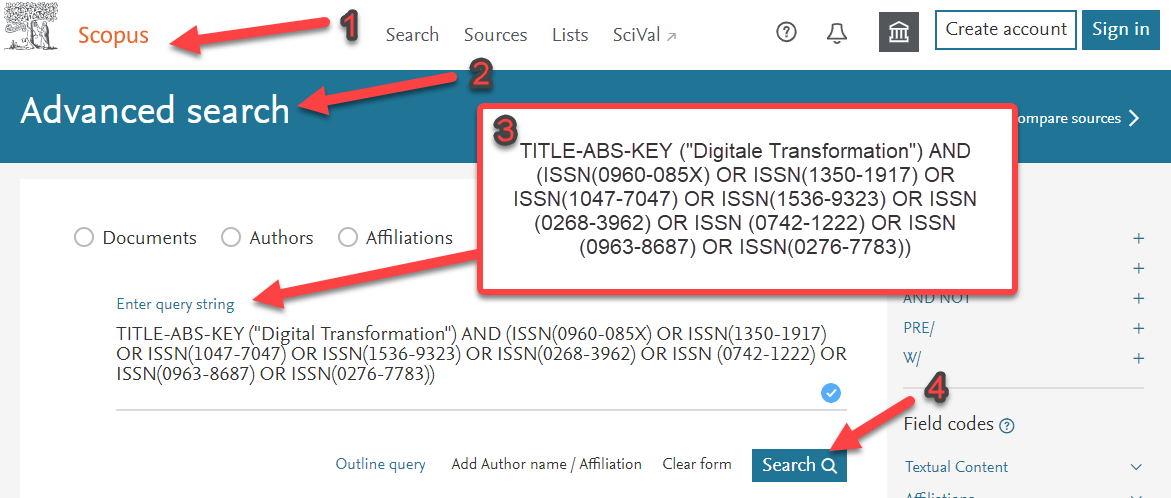
Example: Search with Scopus:
- Specifying the search term—here “Digital Transformation”
- Specify what exactly should be searched—here title, abstract, and keywords this works with Scopus with “TITLE-ABS-KEY”
- Perform search with the following so called query string:
TITLE-ABS-KEY ("Digitale Transformation”) AND (ISSN(0960-085X) OR ISSN(1350-1917) OR ISSN(1047-7047) OR ISSN(1536-9323) OR ISSN(0268-3962) OR ISSN (0742-1222) OR ISSN(0963-8687) OR ISSN(0276-7783)) - Save results
- View results
- If necessary, refine the search, e.g. by adding more search words, and restart at 1. until relevant literature is found.
Figure 1 illustrates the search on www.scopus.com.
Example: Search with EBSCOhost:
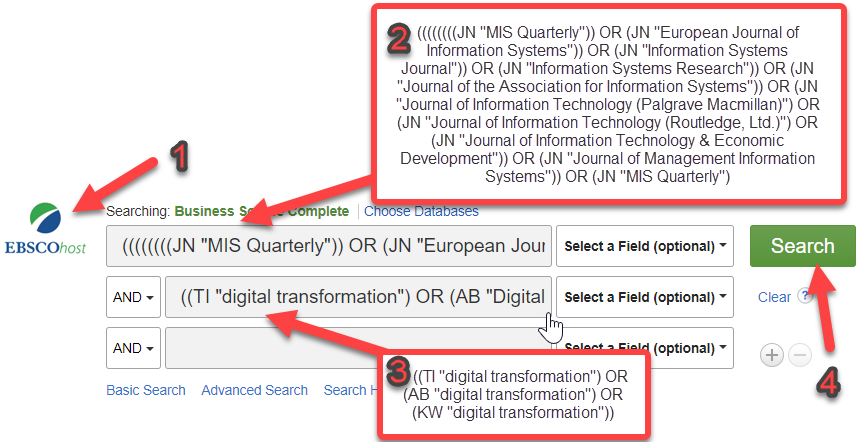
EBSCOhost works only conditionally with ISSN, therefore modify the query string.
((((((((JN “MIS Quarterly”)) OR (JN “European Journal of Information Systems”)) OR (JN “Information Systems Journal”)) OR (JN “Information Systems Research”)) OR (JN “Journal of the Association for Information Systems”)) OR (JN “Journal of Information Technology (Palgrave Macmillan)”) OR (JN “Journal of Information Technology (Routledge, Ltd.)”) OR (JN “Journal of Information Technology & Economic Development”)) OR (JN “Journal of Management Information Systems”)) OR (JN “MIS Quarterly”)
EBSCOhost also uses other parameters for narrowing down the search
((TI “digital transformation”) OR (AB “Digital transformation”) OR (KW “digital transformation”))
Figure 2 illustrates the procedure for the database EBSCOhost.
Evaluation and documentation of search results
The quality of a literature search is reflected not only in the formulation of search queries, but above all in the systematic evaluation of the results. For qualification papers, it is advisable to first export the hits to a literature management program (e.g., Citavi, EndNote, Zotero, or Mendeley). This allows you to remove duplicates, assign keywords, and form initial thematic clusters. Structured categorization—for example, according to theoretical approaches, methods, contexts, or key findings—makes it easier to develop a consistent and clearly structured overview of the current state of research.
At the same time, exclusion criteria should be transparently documented, for example, if certain studies are not considered further due to insufficient methodological quality, inappropriate contexts, or a purely technical focus. Such documentation supports the traceability of the literature selection and increases the scientific transparency of the work. Especially in doctoral projects, the traceably justified selection of articles from basket journals can be an important part of methodological reflection.
Basket of Eight in the Context of Other Journal Lists
Although the AIS Basket of Eight is an important guide, there are other journal lists that are used in particular for a differentiated evaluation of research performance. One example is the list of outstanding journals in information systems research maintained by the “Senior Scholars” of the AIS, which goes beyond the original basket and includes additional, sometimes more specialized journals (AIS - Senior Scholars' List of Premier Journals). For a comprehensive literature search, it may be useful to consult these expanded lists to identify thematically relevant journals that are not included in the basket.
For students and doctoral candidates, this means that the “Basket of Eight” represents a useful core collection of relevant top journals, but should not be used as the sole source of reference. Particularly for interdisciplinary questions—such as those at the interfaces with business administration, computer science, sociology, or public management—it is advisable to include additional journals and conferences in the research. This helps to avoid the risk of your own work overlooking important theoretical perspectives or current empirical findings from related fields of research by focusing too narrowly on a few publications.
The role of Basket of Eight and other journalists in the context of ranking and impact is explained on the page Ranking and Impact in Information Systems.
Advice for students and doctoral candidates
The AIS Basket of Eight offers students in bachelor's and master's programs a high-quality introduction to international literature. When writing seminar papers and theses, it can be useful to first identify key articles from these journals in order to familiarize yourself with basic concepts, established theories, and typical research designs in the subject area. Subsequently, other, often more focused journals can be consulted to examine specific issues in greater detail and to keep abreast of current specialized discourse.
Doctoral students should also consider the “Basket of Eight” as a strategic tool for their own publication planning. The quality standards required by these journals in terms of theoretical foundation, methodological rigor, and contribution to scientific discussion are high and are usually accompanied by long and intensive review processes. Realistic time planning that takes into account the duration of review procedures, possible rounds of revision, and the option of second submissions is therefore essential. At the same time, consistent orientation toward work from the “Basket” journals can help to align one's own research more stringently and ensure connectivity to central discourses in the field.
The overview of Research Methods may be helpful for planning empirical studies whose results you would like to submit to the Basket of Eight journals.
References
[1] AIS 2016: Senior Scholars' Basket of Journals, Assoziation for Information Systems (AIS), https://aisnet.org/?SeniorScholarBasket, accessed at 07/10/2016.
General
The Senior Scholars' List of Premier Journals is a prestigious compilation of first-rate scientific journals recommended by leading experts in their field. This unique list provides researchers and academics with a valuable resource for accessing high-quality, trusted sources and keeping up to date with current developments in their discipline. With its focus on quality and relevance, the Senior Scholars' List of Premier Journals is a reliable guide for authors seeking prestigious publication opportunities. By regularly reviewing and updating the list, it ensures that scholars always have access to the latest findings and cutting-edge research.
The Senior Scholars explicitly regard the list as a professionally curated guide rather than a rigid ranking. Changes in the publishing landscape, the establishment of new journals, or shifts in the thematic focus of individual journals may lead to adjustments, which will be reviewed and decided upon at regular intervals. It is particularly relevant for students and doctoral candidates that the journals listed often play a central role in tenure, appointment, and evaluation procedures and are therefore considered particularly visible publication venues.
In doing so, the list expands the AIS - "Basket of Eight" and was last updated on February 17, 2023. Consequently, the list expands the Literature Research to include outstanding journals in Information Systems. While the Basket of Eight represents a very narrow selection of top journals, the Senior Scholars' List includes a larger number of premier journals that cover additional subdisciplines, methodological approaches, and thematic areas of business informatics. This provides researchers not only with a core set of particularly prestigious journals, but also with a more differentiated map of relevant publication venues in the field.
Practical Use for Research and Teaching
For students and doctoral candidates, the Senior Scholars' List primarily serves as a structured basis for planning and conducting literature searches. When searching for topics, it can be advantageous to first conduct a targeted search in databases such as Scopus or Web of Science to identify relevant articles from the journals listed. This approach enables the identification of key theoretical concepts, established methods, and current debates in the respective field of research. It is essential that theses and dissertations are closely aligned with the leading discourses in the field from the outset.
In a second phase, the list can be used to focus the selection of literature by deliberately examining which articles from premier journals are available for key questions and how these influence one's own argumentation. At the same time, additional, possibly specialized or interdisciplinary journals should be consulted in order to avoid one-sided perspectives and to adequately reflect the thematic breadth of the state of research. For lecturers, it is advisable to explicitly state in module handbooks, seminar descriptions, or guidelines for theses that a certain proportion of the literature used should come from journals on the Senior Scholars' List.
The list can also be used as a guide when planning a publication strategy. Doctoral candidates can reflect on their research project at an early stage to determine which journals are suitable in terms of content and can be realistically addressed in terms of target audience, thematic focus, and methodological requirements. In this context, it should be noted that premier journals usually have strict review processes and longer review periods. These factors must be taken into account when planning doctoral projects and third-party funded projects.
Current Status and Relationship to Other Rankings
The Senior Scholars' List is reviewed and updated at regular intervals to take appropriate account of developments in the discipline and changes in the quality and relevance of journals. The indication of an update date—such as February 17, 2023—enables users to understand the chronological classification of the list and, if necessary, to refer to more recent versions. When planning long-term research and publication projects, it is therefore advisable to check whether the current version of the list corresponds to the latest official version of the AIS.
At the same time, in addition to the Senior Scholars' List, there are other systems for evaluating scientific journals, such as national rankings (e.g., business journal rankings) or bibliometric indicators such as Impact Factor and CiteScore. Some of these pursue different objectives and evaluation logics and can lead to differing assessments of the importance of individual journals. The Senior Scholars' List should therefore be understood as a professionally curated perspective of the international information systems community and used in conjunction with other, particularly nationally relevant, evaluation standards.
Relationship to the AIS Basket of Eight
The AIS Basket of Eight represents a particularly selective subset of the journals that are authoritative in Information Systems Research and focuses on eight widely recognized top journals. In a variety of contexts—such as the evaluation of research performance or the design of doctoral projects—the Basket serves as a symbol for the highest quality segment of the discipline. The Senior Scholars' List builds on the concept of the “Scholar's List,” but expands it to include additional premier journals that represent additional subject areas and methodological approaches.
Students and doctoral candidates are advised to use these two resources in combination. While the Basket of Eight offers a very compact introduction to the leading journals and is well suited as a starting point for an initial, highly focused literature search, the Senior Scholars' List allows for a broader exploration of relevant publications. An internal link to the “AIS – Basket of Eight” page can highlight the connection between the two on the website and make it easier to navigate between the two sources of information.
Application in Teaching and Qualification Work
In academic teaching, the Senior Scholars' List can serve as a basis for developing various didactic formats. In seminars or project work, for example, students have the opportunity to analyze the thematic focus of individual premier journals, identify typical research questions and methods, and compare these with the requirements of their own studies or theses. One possible task is to assign their own research topic to one or more journals on the list and justify why these appear to be particularly suitable places for publication.
For qualification papers, guidelines can stipulate that key theoretical and empirical contributions – where available – should preferably be drawn from journals on the Senior Scholars' List. This promotes high academic quality in the papers and sensitizes students at an early stage to the relevance of renowned publications. It should also be made clear that the list is not to be understood as an exclusion criterion, but rather as a guide that should be supplemented by relevant literature from other, especially interdisciplinary and context-related journals.